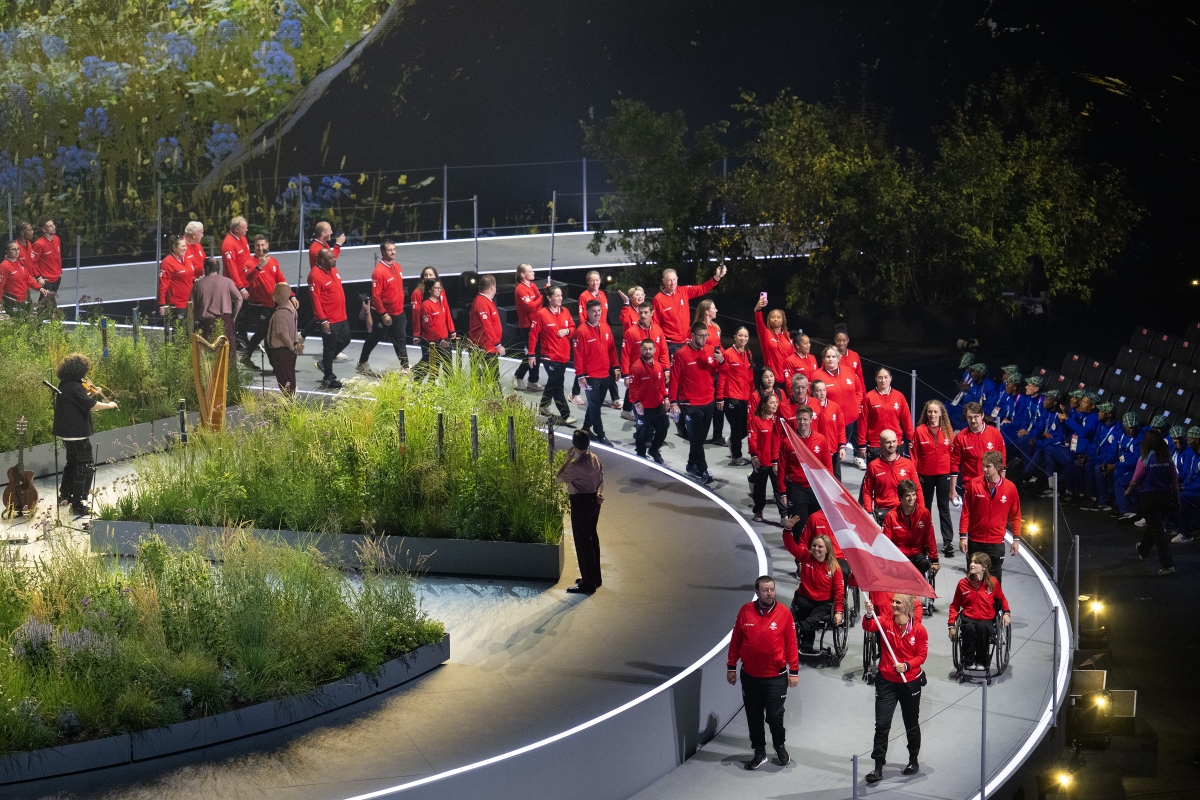
Glasgow Scotland (2026-08-02) - Team Canada 2026 will walk in the closing ceremony tonight for the 2026 Commonwealth Games at the Hydro in Glasgow, with the satisfaction of knowing they embraced every challenge and exceeded expectations at these unique Commonwealth Games. At a Games with a reduced number of sports on the programme, Team Canada achieved its goal of a top three ranking in total medals, amongst all nations and territories competing.
From July 23 to August 2, Team Canada competed at the XXIII Commonwealth Games, winning 62 medals, including 19 gold, 20 silver and 23 bronze. Competing under the theme Mighty, Together, Team Canada featured athletes across nine sports and four para disciplines, bringing together Olympians, Paralympians, Commonwealth champions and the next generation of Canadian sport stars.
One of the hallmarks of Canada's Commonwealth Games program is the opportunity for emerging athletes to compete alongside some of the country's most accomplished international performers. At the 2026 Games, Olympians, Paralympians and returning Commonwealth champions joined first-time multi-sport Games athletes to deliver one of Canada's strongest team performances in recent Commonwealth Games history. Artistic gymnastics and athletics and para athletics led all Canadian sports with 16 medals each. Other highlights included weightlifting adding eight medals, swimming contributed nine, while judo earned seven medals over three days of competition. Athletes representing Quebec accounted for the largest share of Canada's medals, followed by Ontario, highlighting the strength and depth of Team Canada from coast to coast.
The Glasgow 2026 Commonwealth Games marked a defining moment for the Commonwealth Sport Movement, proving that a reimagined Games could deliver world-class competition while embracing sustainability, accessibility and community. With competition concentrated across a compact eight-mile corridor, a streamlined sport program of 10 sports and six integrated Para sports, the Games aimed to demonstrate that world-class multi-sport competition does not depend on size alone. Despite the smaller size, Glasgow organizers showcased the largest Para sport medal program in Commonwealth Games history, reinforcing the movement's long-standing commitment to fully integrated sport. By prioritizing impact over scale, Glasgow 2026 worked to establish a new model for international multi-sport events, one rooted in inclusion, efficiency and legacy, while providing an important stepping stone for many athletes on the road to the Los Angeles 2028 Olympic and Paralympic Games.
"Glasgow 2026 asked every team to think differently, adapt quickly and embrace a new model for the Commonwealth Games," said Kelly Laframboise, Director, Team Canada 2026. "I'm incredibly proud of how Team Canada responded. Our athletes, coaches and mission staff stayed united, supported one another every step of the way and created an environment where Canadian athletes could perform at their very best. Finishing among the top three nations is a testament to the resilience, professionalism and team-first culture that defined Team Canada throughout these Games."
Leading Team Canada in Glasgow was Chef de Mission Erica Wiebe, an Olympic and Commonwealth Games champion whose own Commonwealth journey began at the Commonwealth Games in Glasgow in 2014. Drawing on her experience competing and winning at the highest levels of international sport, Wiebe proudly led the Canadian delegation and helped create an environment in which athletes could perform at their best while embracing the unique experience of representing Canada at the Commonwealth Games.
"Coming back to Glasgow as Chef de Mission after beginning my own Commonwealth journey here in 2014 has been incredibly meaningful," said Erica Wiebe, Chef de Mission, Team Canada 2026. "Every athlete on this team wrote their own story, whether they stood on the podium, achieved a personal best or represented Canada at their first major Games. What I'll remember most is the way this team supported one another, celebrated each other's successes and truly embodied what it means to be Mighty, Together."
The Glasgow 2026 Commonwealth Games featured approximately 3,000 athletes from 74 nations and territories competing across 10 sports and six para sports in one of the most compact Games in Commonwealth history.
Team Canada for the 2026 Games included 148 athletes competing across nine sports and four para disciplines. The team was supported by 91 coaches, managers and support staff. Mighty, Together was more than Team Canada's theme in Glasgow, it was reflected in every performance and every celebration. Athletes from every corner of the country came together as one team, proving that Canada's diversity is its strength. Whether competing for medals, achieving personal bests or making their Commonwealth Games debut, Team Canada demonstrated that belonging, inclusion and unity are as much a part of Canadian success as athletic excellence.
Team Canada 2026 result highlights include:
Canadian athletes competed in nine sports: Athletics, Bowls, Boxing, Cycling, Artistic Gymnastics, Judo, Swimming, Wheelchair Basketball and Weightlifting.
Medals were won by Olympic champions, Paralympic athletes, Commonwealth veterans and Games debutants,
Artistic gymnastics and Athletics and Para athletics each contributed 16 medals each.
Canada won medals in eight of the nine sports Canada competed in including: Swimming, Artistic Gymnastics, Athletics/Para Athletics, Cycling, Weightlifting, Judo, Boxing, 3x3 Wheelchair Basketball.
Medals were won by athletes from across Canada, including: British Columbia, Alberta, Saskatchewan, Ontario, Quebec, and Nova Scotia.
Kylie Masse became the most decorated Canadian female athlete in the pool with 11 total Canadian medals won at the Commonwealth Games.
Ryan Bester became Team Canada's most experienced athlete, competing in his seventh Commonwealth Games in lawn bowls.
Team Canada included its largest Para contingent ever at a Commonwealth Games, reflecting the continued growth of Para sport within the Commonwealth movement.
The team featured 78 female athletes, 70 male athletes, and a record 35 para-athletes.
Team Canada featured 37 coaches representing seven Provinces.
Canada set Commonwealth Games records in the pool (Liendo: Men's 100m Butterfly), at the track (Rogers: Women’s Hammer Throw), (Haase: Women’s 100m T47) and in weightlifting (Taschereau: Women’s 58kg), (Charron: Women's 63kg - Clean & Jerk and Women's 63kg – Snatch), (Simoneau: Women's 69kg - Clean & Jerk and Women's 69kg – Snatch), (Bellemarre: Men’s 94kg)
In weightlifting, Maude Charron (Rimouski, QC) repeated as the Commonwealth Games Champion for the third time.
Click here for a full account of all Commonwealth Games medals in Glasgow 2026.
The 2026 Games were also full of heartwarming moments such as Reid Maxwell setting a Commonwealth Games record in preliminaries while swimming up a class, Ariane Fortin returning to the Commonwealth Games as a coach after competing for Canada in 2014 and winning a silver medal in boxing and Sheriauna Haase and Chloe Dunbar going 1-2 in the 100m T47 final at the stadium. Family was also front and centre, with athletes celebrating wins and disappointments with family in Glasgow, including parents and spouses but also children for some of our most decorated alumni.
Looking ahead, the Commonwealth Sport movement has already turned its attention to the milestone 2030 Commonwealth Games, which will mark the 100th anniversary of the first Games held in Hamilton, Ontario, in 1930. During its General Assembly in Glasgow in November 2025, the 74 Commonwealth Sport member nations and territories unanimously confirmed Amdavad (Ahmedabad), India, as the host city for the centenary edition. India previously staged the Commonwealth Games in Delhi in 2010, and organizers plan for Amdavad 2030 to feature approximately 15 to 17 sports, ushering in a new chapter for one of the world's longest-running international multi-sport events.
Canada is the birthplace of the Commonwealth Games, having hosted the first ever Games in Hamilton in 1930, which were then known as the British Empire Games. Canada hosted the Commonwealth Games 4x to date – Hamilton (1930), Vancouver (1954), Edmonton (1978) and Victoria (1994).
Visit http://commonwealthsport.ca for news, photos, videos, social media links and to download the complete 2026 Team Canada media guide.
Click here for a full list of all the Team Canada athletes and coaches.
ABOUT TEAM CANADA 2026
The 2026 Commonwealth Games will bring together 74 nations and territories in a celebration of sport, culture, and community. Team Canada will once again compete with pride, unity, and determination on the global stage on this important path to Olympic and Paralympic success. Team Canada will feature 148 athletes, 91 team officials. Canada’s performance projection in 2026 is a top three ranking, in total medals, amongst all nations and territories competing. Team Canada’s dedicated mission team will provide an optimal environment by celebrating equality, diversity, and non-discrimination. This is in support of our goals needed to enable a best ever performance by Canadian athletes at the 2026 Commonwealth Games.
ABOUT COMMONWEALTH SPORT CANADA
Commonwealth Sport Canada (CSC) is the franchise holder for the Commonwealth Games and the Commonwealth sport movement in Canada. CSC supports Canada’s athletes to achieve excellence at Olympic and Paralympic Games and world championships and enriches the lives of youth across the Commonwealth and hosts the Commonwealth Games. For additional information go to: www.commonwealthsport.ca.
For more information, please contact:
Patrick Kenny
Chief Communications Officer, Team Canada 2026
Email: [email protected]
(613) 724-7160